
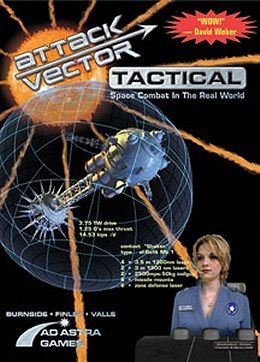
Attack Vector: Tactical (2004) Board Game

Attack Vector: Tactical is a science fiction wargame that was first released in in 2004. Designed by Ken Burnside, Winchell Chung, Charles Oines, and Joshua Qualtieri, this game is known for its detailed simulation of space combat. With a focus on realistic physics and three-dimensional movement, Attack Vector: Tactical offers players a unique and challenging gaming experience.
Game Components of Attack Vector: Tactical
How To Setup Attack Vector: Tactical
Setting up Attack Vector: Tactical involves preparing the hexagonal grid, distributing ship control cards, and assembling the necessary play aids like tilt blocks and attitude markers. The game requires a fast setup time, but the initial learning curve can be steep due to the complex rules and mechanics. Players need to familiarize themselves with the extensive play aids, such as the AVID and RALT, to ensure smooth gameplay.
Gameplay Mechanics and Game Objective
Player Experience
Playing Attack Vector: Tactical is an immersive experience that combines strategic planning with tactical execution. The game demands attention to detail, as players must manage complex systems like power generation, heat dissipation, and precise movement. The learning curve is significant, requiring 2-5 hours to fully understand the rules, but the game rewards players with a deeply realistic and engaging space combat simulation. The game is suitable for 2 to 8 players, with a playing time of 1.5 to 4 hours.
Pros
Cons
Personal Thoughts on Attack Vector: Tactical
Attack Vector: Tactical is ideal for enthusiasts of hard science fiction and those who appreciate realistic space combat simulations. It is not a game for the faint of heart, as it demands a significant investment of time and effort to learn. However, for players who relish complex strategy and realistic mechanics, this game offers a unique and rewarding experience. If you are looking for a game that challenges you with real-world physics and engineering, Attack Vector: Tactical is an excellent choice.
We are supported by our audience. When you purchase through links on our site, we may earn an affiliate commission, at no extra cost for you. Learn more.
