| | | | | |

Piecepack (2001) Board Game

The Piecepack board game was created by James Kyle and released in in 2001. It is a unique game system that allows players to customize their games using a set of standardized components. The game was designed to be versatile and accessible to players of all ages.

Game Components of Piecepack

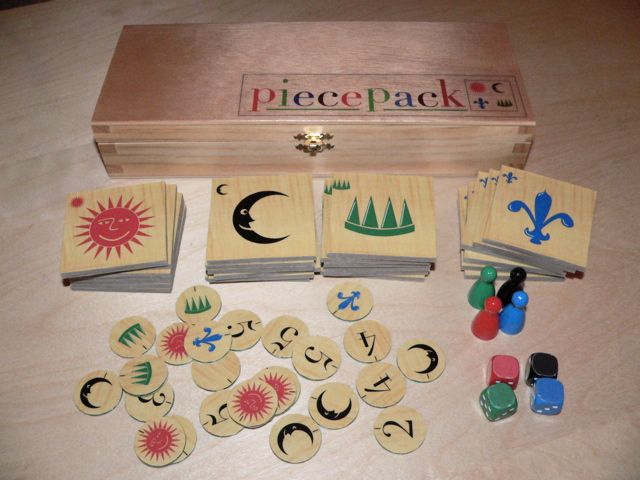
  • 24 Tiles: Each tile has a rank (null, ace, 2-5) and a suit (red suns, black moons, green or yellow crowns, blue arms).
  • 24 Coins: Coins have ranks and suits, with markers to indicate direction.
  • 4 Dice: Custom dice with ranks matching the tiles (null, ace, 2-5).
  • 4 Pawns: Pawns are colored according to their suits and can have various shapes.

    How To Setup Piecepack

    To set up a Piecepack game, the specific setup can vary depending on the game being played. However, a common setup involves:

  • Arranging the tiles face down to form a grid, which can be a 4×4 or 8×8 grid depending on the game.
  • Placing coins and pawns according to the game’s rules. For example, in one game, coins are placed randomly on the grid, and pawns are positioned based on specific placement rules.

    Gameplay Mechanics and Game Objective

    Gameplay Mechanics

  • Tile Placement: Tiles form the playing surface, often with a grid on the back for modular board games.
  • Coin and Pawn Movement: Coins and pawns are moved according to game-specific rules, sometimes requiring strategic planning and calculation.
  • Dice Rolling: Dice are used to determine outcomes or to decide player actions.

    Game Objective

  • The objective varies by game but often involves collecting items (like cheese in one game), surviving on a melting iceberg, or building cities while managing earthquakes.

    Player Experience

    Playing with a Piecepack offers a diverse and dynamic gaming experience. Players can engage in over 225 different games, ranging from simple abstract games to complex strategic ones. The system’s versatility allows for both solo and multiplayer experiences, making it a great addition to any game collection. However, the learning curve can be steep due to the numerous rules and variations across different games.

    Pros

  • High Versatility: Can be used to play a wide variety of games.
  • Public Domain: Allows anyone to create and share new games using the Piecepack system.
  • Customizable: Components can be customized or expanded to fit different game designs.
  • Portable: The set is relatively small and easy to carry.

    Cons

  • Complex Rules: Some games have complex rules that can be confusing at first.
  • Component Consistency: Variations in component designs can sometimes make games unplayable or inconsistent.
  • Limited Components: Some games may feel limited by the number of pieces available.

    Personal Thoughts on Piecepack

    The Piecepack is ideal for game enthusiasts who enjoy exploring various game mechanics and themes. It is particularly suited for those who appreciate the flexibility of a system that can be used to play numerous different games. While it may not be the best fit for casual gamers due to its complexity, it offers a rich and engaging experience for those willing to delve into its depths. It’s a great tool for game designers and hobbyists looking to prototype new games or adapt existing ones to the Piecepack system.

    We are supported by our audience. When you purchase through links on our site, we may earn an affiliate commission, at no extra cost for you. Learn more