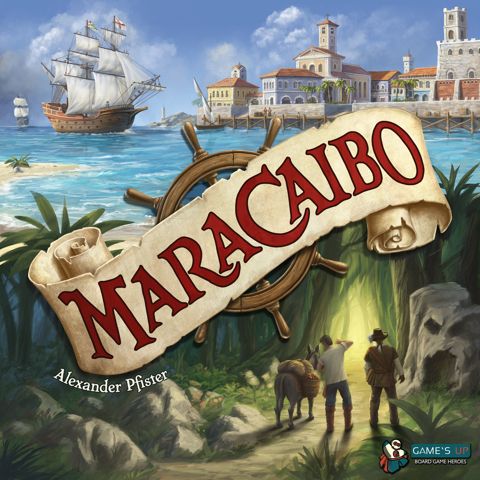
Maracaibo is a board game designed by Alexander Pfister and published by Game’s Up in in 2019. The game is set in the 17th century Caribbean, where players take on the roles of explorers, merchants, and pirates, seeking to gain wealth and influence in the region.
Game Components of Maracaibo
Player boards: Each player has a personal board with various spaces to uncover, providing additional action options and bonuses.Wooden bits: Includes an explorer, workers, a ship, and markers for different tracks.Cards: Multi-use cards for actions, bonuses, and upgrades.Story cards: Used for campaign and non-campaign games, providing specific objectives and narrative elements.Influence tracks: Markers for tracking influence with different nations.Exploration track: A board section for exploration, offering bonuses and victory points.Ship board: For upgrading and managing ship capabilities.Combat tiles/dice: For resolving combat and raiding in the *Pirates of Maracaibo* variant.
How To Setup Maracaibo
To set up *Maracaibo*, each player starts with a personal board, wooden bits, and a set of starting cards. The main board is laid out with the sailing path, influence tracks, and the exploration track. Players place their ships in Havana, the starting point. Story cards are set out based on whether you are playing the campaign or a non-campaign game. The deck of cards is shuffled, and each player draws a starting hand.
Gameplay Mechanics and Game Objective
Tableau-building: Players manage a tableau of cards to create combos and execute strategies.Resource management: Managing doubloons, goods, and influence points.Area influence: Gaining influence with different nations to score victory points.Exploration: Moving along the exploration track to gain bonuses and victory points.Ship upgrades: Upgrading the ship to gain better actions and bonuses.Combat/raiding: Engaging in combat or raiding to secure treasure and points.Round management: The game is played over four rounds, with each round ending when a player reaches the end of the sailing path.Scoring: Points are awarded based on influence tracks, prestige buildings, and final card and treasure scores.
Player Experience
*Maracaibo* offers a rich and complex gaming experience, with numerous paths to victory. Players must balance movement, spending, and card usage to maximize their points. The game is known for its deep strategy, requiring careful planning and execution.
Pros
Deep strategy: Many choices and paths to victory, appealing to fans of complex games.Theme integration: The historical Caribbean theme is well-integrated into the gameplay mechanics.Player board progression: Uncovering spaces on the player board adds new actions and bonuses.Upgraded mechanics in *Pirates of Maracaibo*: Streamlined combat and ship upgrades enhance gameplay.
Cons
Steep learning curve: The game has a lengthy rules explanation and many components to manage.Busy gameplay: Some players find the game too complex with too many things to keep track of.Sensitive theme: The historical setting includes elements that might be sensitive for some players.
Personal Thoughts on Maracaibo
*Maracaibo* is ideal for fans of heavy eurogames and those who enjoy complex strategy and tableau-building mechanics. While it may not be the best fit for players seeking a light or casual gaming experience, it offers a rich and rewarding experience for those willing to invest the time to learn and master its intricacies. If you enjoyed Alexander Pfister’s other games, such as *Great Western Trail* or *Mombasa*, you might find *Maracaibo* to be a compelling addition to your gaming collection. However, the game’s complexity and sensitive theme should be considered before making a purchase.
We are supported by our audience. When you purchase through links on our site, we may earn an affiliate commission, at no extra cost for you. Learn more.