
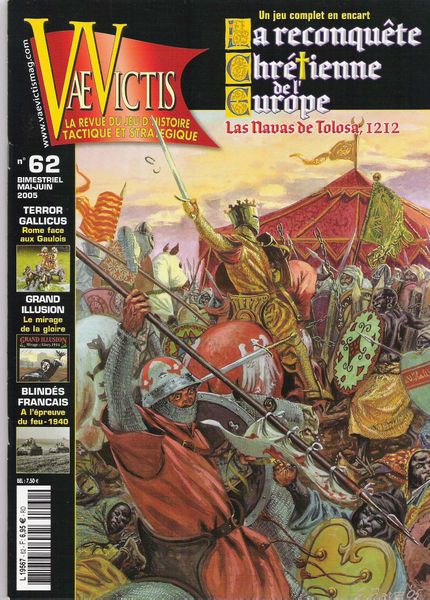
Las Navas de Tolosa, 1212 (2005) Board Game

Las Navas de Tolosa, 1212 is a historical wargame that focuses on the Battle of Las Navas de Tolosa, which took place in 1212 during the Reconquista period in Spain. This battle was a significant turning point in the Christian reconquest of the Iberian Peninsula from the Moors.
Game Components of Las Navas de Tolosa, 1212
How To Setup Las Navas de Tolosa, 1212
To set up the game, the Muslim player sets up on one side of the board and the Christian player on the other. Each player places three chits into their corresponding spaces on the board. Each player is then dealt three cards. The remaining cards are placed face-down and will be used later to determine attack strengths.
Gameplay Mechanics and Game Objective
– Players play one card face-down to determine initiative.
– The player with the highest number in their color takes the initiative.
– Each turn, a player plays one of their remaining cards face-up to determine APs.
– Players use APs to move, refresh units, or attack.
– Attacks are resolved by flipping the top card from the face-down deck; the red number for Christians and green for Muslims determine attack strength.
– Christians win by eliminating the Muslim leader or occupying twice as many zones as the Muslims.
– Muslims win if Christians have no units in the Muslim zone and occupy four or fewer zones overall.
Player Experience
The game offers a tactical and strategic experience with a mix of strategy and luck. Players must make tactical decisions about which cards to play for initiative and action points. Each side has unique strengths: Christians have powerful cavalry, while Muslims have strong archers and a potent counter-attack. The game requires players to learn the different strategies for each side, as the approach cannot be the same. The damage system is straightforward, with units having two hit points and the option to heal units, though healing exhausts them for the turn.
Pros
Cons
Personal Thoughts on Las Navas de Tolosa, 1212
This game is ideal for fans of tactical war games and those interested in historical battles. It is particularly suited for players who enjoy asymmetric gameplay and the strategic challenge of adapting to different playstyles. While it may not be the best fit for those looking for a game with a large player count or a game that can be learned in a single play, it offers a rich and engaging experience for those willing to invest time in mastering its mechanics.
We are supported by our audience. When you purchase through links on our site, we may earn an affiliate commission, at no extra cost for you. Learn more.
